Author Archives: admin

Industrial Control System Attackers & Attackees

ics_attackers2

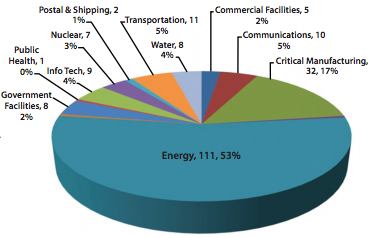
ICS attacks by business sector
(image ICS-CERT)

—  ICS-CERT  responds to over 200 Industrial Control System (ICS) incidents between October 2012 and May 2013.
— Highest percentage in energy sector — 53%
— Critical Manufacturing sector follows — 17%


ICS attacks by source country (image TrendMicro)

ICS attacks by source country
(image TrendMicro)

— TrendMicro research emulates Industrial Control System with honeypots
— Only takes 18 hours for first honey pot to be attacked
 — Over 28 days, 39 attacks from 14 countries
— Of 39 attacks, 12 were unique and considered ‘targeted’
— Attackers demonstrated experience & expertise with ModBus industrial control protocol


Avoiding a Tragedy of the Commons

So maybe SMB Information Risk & Security doesn’t have to be a Tragedy of the Commons.

Admittedly, at initial glance it appears that it has to be. So many SMB’s have so few resources — they rarely have security expertise, typically have very little IT expertise, and probably zero information risk management expertise. Again, the reasons for this are not difficult to see. Their resources are limited and many of the traditional enterprise approaches to risk and security simply don’t scale down cost-effectively. 

What's one more fish? (Image by Earth'sbuddy [CC-BY-SA-3.0] via Wikimedia Commons

What’s one more fish?
(Image by Earth’sbuddy [CC-BY-SA-3.0] via Wikimedia Commons)

This is why risk and security for SMB’s can appear to be a Tragedy of the Commons. As discussed a couple of posts ago, a Tragedy of the Commons as introduced by Hardin in 1968 covers such scenarios as overfishing a portion of the ocean or overgrazing a pasture. Each individual actor, whether fisher getting one more fish or farmer putting one more cow on the pasture, contributes to the demise of the shared resource for all in the long-term while acting on self-interest in the short-term.

Similarly, it was suggested in the post, that the Internet is a shared resource for SMB’s. When an individual business is attacked, 1) the business can suffer itself, and/or 2) the business is used as an attack platform on other businesses which diminishes, i.e. depletes, the utility of the resource. However, in the short-term, the SMB has a hard time justifying risk management and security investment on its own behalf because it requires internal resources bound for marketing, R&D, production and similar.

Solution to Prisoner’s Dilemma Approach

The Tragedy of the Commons idea introduced by Hardin is similar to the Prisoner’s Dilemma  where it is assumed that there is no (or little) communication between actors – prisoners, in this case. While working independently and integrating previous and existing research, Elinor Ostrom  , 2009 Nobel Prize Winner for Economic Sciences (shared with Oliver Williamson), showed that there were many examples of successful sharing of a common pool resource (CPR). She asked the question, “Are rational individuals helplessly trapped in dilemma’s?” To answer this, she studied irrigation systems in Nepal, forests around the world, fisheries, police and government systems, as well as studies in her own laboratory.

Among other things, she clearly pointed out that there was indeed communication between the actors that were successfully sharing a Common Pool Resource. Further, a key component amongst actors in successful common sharing was trust.

Polycentric Governance Success

Follows are a number of her observations from her Prize Lecture entitled, “Beyond Markets and States: Polycentric Governance of Complex Economic Systems” . I am not suggesting that these observations directly map into the Common Pool Resource problem of SMB’s sharing the Internet. However, I do believe that they are worthy of reflection in this context and can serve as the basis for further discussion. (That said, I think the title itself may hold clues to the SMB Tragedy of the Commons problem.)

  • panaceas are potentially dysfunctional
  • small to medium-sized cities are more effective monitors of performance & costs
  • dissatisfied citizens (group members) can ‘vote with their feet’ and move to another group
  • large, incorporated communities can change contracts with external providers, but urban, less structured, districts have no voice
  • Re police in metropolitan areas, large number of direct service producers (e.g. patrol) more efficient while small number of indirect service producers (e.g. dispatch, crime lab analysis) more efficient — that is, most efficient was mix of large and small
  • complexity is not the same as chaos and it is often worth the investment to better understand the complexity
  • groups that did not communicate were more likely to overuse the shared resource
  • 5 types of property rights discovered, not just one (access, withdrawal, management, exclusion, & alienation rights)

Successful shared resource scenarios tended to have these traits:

  • boundaries of users & resource are clear
  • congruence between benefits & costs
  • actors had procedures for making their own rules
  • regular monitoring of resource and actors
  • graduated sanctions (against rule violators)
  • conflict resolution mechanisms
  • minimal recognition of rights by government
  • nested enterprises
  • users/actors themselves are active monitors of resource consumption (i.e. not a 3rd party)

Other observations:

  • users monitoring resource themselves more important than type of resource ownership
  • stronger when local communities have strong rule-making autonomy and incentives to monitor
  • behavioral theorists now looking at actors/individuals where individual is boundedly rational, but can learn
  • learning to trust others is central to cooperation
  • healthy resources have actors/users with long-term interests in the resource and invest in monitoring and building trust

What are parallels between these observations and secure-SMBs-on-the-Internet-Tragedy-of-the-Commons issue? Should government intervene? (these observations don’t make a strong case for it) Should trade groups organize rules? Should small, geographically similar SMB’s develop their own working groups somehow? Should SMB’s across the globe of similar size organize and develop membership rules re Internet participation? Are there other natural alignments amongst SMBs?

How do we increase the safety and security and lower the risk profile of SMB’s on the Internet?

SMB Information Risk & Security — A Tragedy of the Commons?

Do small and medium sized businesses (SMB’s) erode their common resource, the Internet, by not making an investment in managing information risk and security in their own operations?

Garrett Hardin -- between a rock and a hardplace

Garrett Hardin — between a rock and a hardplace

Garrett Hardin (1915-2003) introduced the idea of individual actors depleting a common resource in his 1968 paper published in Science entitled The Tragedy of the Commons.  The idea is that individuals, making use of a common resource, will make decisions in their own interest to the detriment of the the group as a whole — even knowing that they are a part of that same group that will suffer.

Overfishing

A classic example is overfishing an area.  In theory, all of the individuals fishing know that if they catch more than X fish in a certain period of time that they are contributing to the permanent depletion of that resource — which ultimately affects them.  However, when thinking for themselves, they think, ‘if I don’t get that extra fish, someone else will. So it might as well be me.’

Cow_female_black_white-wikiAnother example is multiple farmers with cows grazing on the same common pasture.  Some number of total cows is sustainable and the grass will regrow in time to continue feeding all of the cows.  Beyond that point, the pasture will degrade until it is eventually totally consumed.  While overgrazing is detrimental to all, each individual farmer thinks, ‘if I don’t maximize this and put more cows on the field, I’ll suffer in the short term — I’m not even thinking about the long term.  I’m just trying to keep up with or beat the farmer next to me this week.’ As a result, the resource becomes completely depleted.

Hope on the horizon?

Elinor Ostrom (1933-2012) received the Nobel Prize for her work showing that in many systems with a common resource, individuals communicate with each other and develop working relationships such that the resource is not depleted.  More on her work in a subsequent post.

Elinor Ostrom -- maybe we can figure it out

Elinor Ostrom — maybe we can figure it out

Internet as Common Pool Resource (CPR)

It’s not hard to draw the analogy of Internet as common resource for SMB’s (as well as large enterprises and consumers).  When a company connects to the Internet, it is participating in that resource.  It gets value from the resource.  It also has the potential to harm the resource, and in effect, deplete the resource.

Large enterprises have more resources available for risk management and security activities and can be more motivated to protect their own investments.  I would hazard a guess that, on average, SMB’s have more risk tolerance than most large established enterprises.

When an SMB is attacked or ‘compromised’, a couple of things can happen: 1) the SMB suffers financial or reputation loss or both, and/or 2) the SMB’s resources (computers) are used as assets to attack the computers of other businesses.  This weakens, or depletes, the community resource.

SMB’s typically have less resources when compared to their large enterprise counterparts.  It’s a hard decision to divert limited cash from marketing, production, and R&D to spend it on information risk management and security.  However, not making an investment in security and risk management, significantly exposes themselves as well as the common pool resource of the Internet to harm.

So whose responsibility is it?  SMB’s represent a large portion of the workforce, with each workforce member potentially with one or many computing devices.  If SMB’s aren’t motivated to invest in risk management and security, this means that a substantial part of the economy is operating while poorly protected.

Should SMB’s be held accountable if their computers are hacked and then used to attack other computers? Should SMB’s have a minimum standard for computing devices, to include smartphones? Would this stifle innovation? Should trade organizations establish standards?  The government?

Or, do SMB’s simply represent a tragedy of the commons?

Adm Mike Mullen at Gartner Summit

What keeps Adm Mike Mullen up at night — from Gartner Risk & Security Summit 2013 keynote:

  1. National debt
  2. K-12 education system
  3. Political paralysis
  4. Cyber vulnerability, threats, and infrastructure
  5. Veterans health, education, & employment (1000 veterans leaving service every day, but only 100 being hired everyday)

More on cyber —

  • Adm Mullen went on to say that cyber risk is primary existential threat (ie potential to change way of life) to US.
  •  Calls partnership between presidents Obama and Xi most important bilateral relationship in world
  • Restated his belief in the assumption of breach approach to information security
  • On accountability, concerned accountability is not clear in cyber world. Wants to see leadership and accountability in social networking world.


IT Risk Management Lessons Learned

From Tom Scholtz’s presentation at Gartner Security & Risk Summit 2013 on lessons learned in IT Risk Management:

  • Understand that there is a limited appetite for risk management as a topic by business users (ie, don’t overdo it)
  • Ideally, risk assessment is performed on business processes (vs IT assets or services)
  • Risk interpretation is personal — there is no correct answer
  • Don’t try to use only one risk assessment method for all assessment scenarios — one size does not fit all
  • Don’t use security & risk operational metrics when communicating risk to leadership — convert them to business objectives
  • Risk affinity for individuals and organizations changes over time
  • In many IT risk cases, quantitative risk analysis is impossible (because of lack of relevant actuarial data)
  • In the quest to simplify, don’t try to roll up multiple independent risks into one metric
  • Always link risk management activities to business objectives
  • Focus on risks that we can do something about

Finally, while possibly an unpopular sentiment amongst some practitioners, risk should be treated more like an art than science, where the focus is on gaining and documenting experience* and continuous improvement.  *(See my post Inverting Sun Tzu).

Meet the New Boss … Reincarnated malware returns to SMB’s

Same as the old boss …

A popular form of malware called ZeuS/Zbot has made a comeback and SMB’s are particularly at risk.  Initially identified in 2007,  the malware typically steals user credentials for banking activity.  SMB’s have higher risk exposure because they typically don’t have the resources for risk and security programs.  One SMB, a Maine construction company, was robbed of almost $600,000 in 2009.

ZeuS/Zbot source code is known to be readily available on underground informal networks as well as, apparently, even available for sale.

Back because it works

Once thought to be largely eradicated, ZeuS/ZBot is back because of market analysis and software upgrades.  SMB’s typically have a richer target (bigger accounts) than individuals and are also generally less protected than larger businesses.  Facebook is also providing a new and effective ‘attack vector’ for getting the malware onto user computers to steal data.

How does it work ?

ZeuS/Zbot uses a ‘Man-In-The-Browser’ (MITB) attack. Once a machine is infected, Zbot is able to monitor web activity and watch for particular banking sites.  User credentials are copied and replicated on a database maintained by the attacker. With this information, attackers or their proxies (‘mules’) can login and transfer money wherever they’d like.  By downloading a configuration file established by the attacker, the list of banking sites can be updated.

Prevention/due care activity for SMB’s includes:

  • Move banking activity to dedicated machines used for no other purpose than banking
  • Educate employees on threats, risks, and behavior
  • Review high risk accounts (eg big balances) and access/authorization to them
  • Keep antivirus/antimalware software current
  • Implement a simple information risk management plan (Shocking!)

What percentage of your computers have current antivirus scanning? How do you know?

Default Passwords

Why is it important to change default passwords on hardware, applications, and other systems? Because the passwords are published and, in effect, not passwords at all.  A few responses from Googling ‘default passwords’ :


And there’s plenty more.

Lesson:

Default password = No password

FIS Spends Over $100 million in Breach Response

Fidelity National Information Services (FIS), a large banking services company, was hacked in 2011 and information from that breach was used in a $13 million ATM theft.  Initial reports said damage was limited to a small portion of its organization.  Subsequent audit reveals a much larger breach plus apparently poor management of its incident response.

  • More than $100 million spent in response to breach
  • An FDIC audit showed that since the breach & response that many machines still have default, no, or poor passwords
  • An FDIC vulnerability scan found over 10,000 instances of default passwords in use
  • FDIC report in November 2012 shows 18,747 network vulnerabilities and 291 application vulnerabilities presented as past due

More here